


Learn how potential matches are identified, evaluated, and scored
This article explains the logic behind Resource Matching and Resource Matching Intelligence. It focuses on how candidate records are retrieved, how identity alignment is evaluated, how Match Confidence is generated, and what safeguards help reduce false positives.
Resource Matching evaluates likelihood, not certainty. Users always remain responsible for reviewing information and making final decisions.
How Resource Matching works
Resource Matching evaluates records in a series of stages.
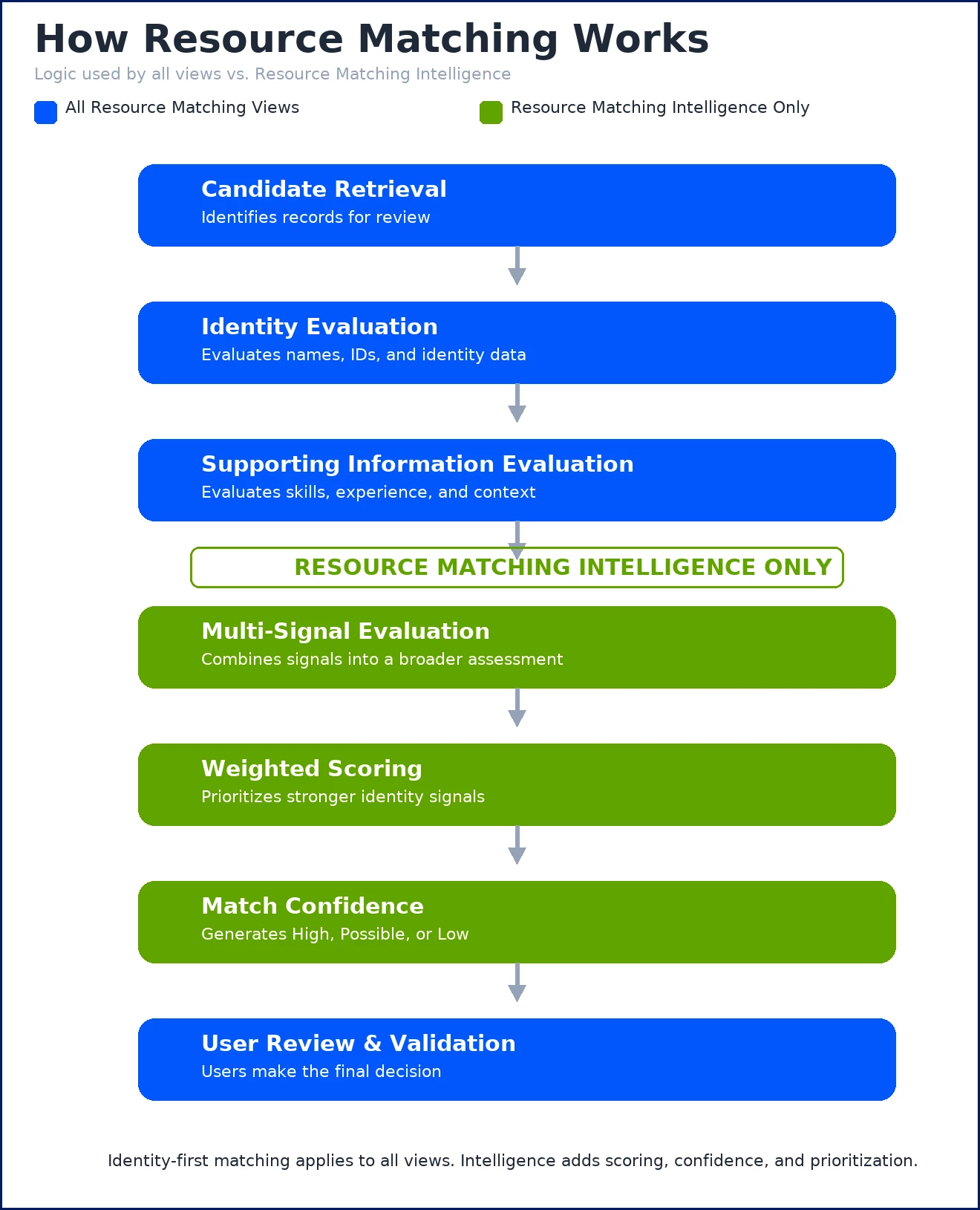
| Stage | Purpose |
|---|---|
| Candidate Retrieval | Identifies records that may represent the same individual |
| Identity Evaluation | Evaluates names, identifiers, and identity information |
| Supporting Information Evaluation | Evaluates additional context such as skills, experience, and resume information |
| Multi-Signal Evaluation* | Evaluates multiple signals together |
| Weighted Scoring* | Gives greater influence to stronger identity signals |
| Match Confidence* | Generates a High, Possible, or Low confidence level |
| User Review and Validation | Requires users to review information and make the final decision |
* Resource Matching Intelligence only.
✅Every Resource Matching view uses the same retrieval and identity-evaluation foundation. Identity information drives matching outcomes, while supporting information provides additional context. Resource Matching Intelligence extends that foundation with multi-signal evaluation, weighted scoring, Match Confidence, semantic evaluation, and result prioritization.
What applies to all Resource Matching views
The following logic applies to Essential, Enhanced, and Resource Matching Intelligence views.
All three views use the same matching foundation. Resource Matching Intelligence adds evaluation depth and confidence-based prioritization, but it does not change the core matching rules.
Candidate retrieval
Resource Matching begins by identifying records that may represent the same individual. Potential candidates are retrieved using trigger-based matching.
A retrieved record is not automatically considered a match. Retrieval only determines which records should be reviewed.
Matching triggers
| Trigger | Comparison method | Purpose |
|---|---|---|
| First Name | Soundex phonetic comparison | Identifies similar sounding first names |
| Last Name | Soundex phonetic comparison | Identifies similar sounding last names |
| Middle Name (optional) | Soundex phonetic comparison | Provides additional retrieval support |
| *Beeline ID | Direct comparison | Identifies existing identity relationships |
| Initial Personal ID | Direct comparison | Identifies matching source identity values |
*Not used for Resource Matching Intelligence.
Soundex matching
Names are often entered differently across suppliers, workflows, and systems. To improve candidate retrieval, Resource Matching uses Soundex-based phonetic matching. Soundex helps identify similar-sounding names even when spelling differs.
Examples
| Name A | Name B |
|---|---|
| Jon | John |
| Smith | Smyth |
| Tunn | Ton |
Important
Soundex improves candidate retrieval. Soundex helps identify candidates for review. It does not determine the outcome.
Soundex does not:
- Confirm identity
- Confirm a match
- Replace user validation
Identity-first evaluation
After candidates are retrieved, Resource Matching evaluates identity alignment. Identity alignment is required before confidence can increase significantly.
Identity information is always evaluated first because it provides the strongest evidence that two records represent the same individual.
Identity information
Examples include:
- First Name
- Last Name
- Middle Name
- Email Address
- Initial Personal ID
Supporting information
Supporting information provides context after identity alignment exists. Examples include:
- Phone numbers
- Address information
- Skills
- Certifications
- Education
- Resume information
- Work experience
- Professional history
Supporting information can strengthen confidence, but it cannot independently establish identity.
Important
Identity information remains the primary driver of matching outcomes. The following by themselves are not sufficient to establish identity:
- Similar skills
- Similar job titles
- Similar experience
- Similar resumes
- Similar certifications
Example
- Matching email addresses provide strong identity evidence.
- Similar job titles alone do not establish identity.
- Similar experience alone does not establish identity.
How data is evaluated
Different types of information require different comparison methods. The comparison method depends on the type of information being evaluated.
| Data type | Evaluation method |
|---|---|
| Names | Soundex and similarity comparison |
| Email Address | Direct comparison |
| Initial Personal ID | Direct comparison |
| Other identity data | Direct comparison |
All Resource Matching views follow the same evaluation flow:
- Retrieve candidate records
- Evaluate identity information
- Evaluate supporting information
- Present results for review
- Require user validation
Users always make the final decision.
User validation
Resource Matching evaluates likelihood, not certainty.
All views require users to:
- Review candidate records
- Compare available information
- Validate identity alignment
- Make the final decision
Resource Matching does not:
- Automatically merge records
- Automatically resolve conflicts
- Automatically determine identity
- Automatically make onboarding decisions
✅ The system provides guidance. Users determine the outcome.
Identity continuity and key records
Resource Matching helps maintain identity continuity across suppliers, assignments, onboarding activities, and reporting processes.
Key identity records
| Term | Description |
|---|---|
| Beeline ID | System-generated identifier used to maintain identity continuity across suppliers, assignments, and workflows Aka Private ID or Resource ID A system-generated unique identifier used to match resources across records. The ID is based on the information provided by a supplier for the individual’s Initial Personal ID. The format is typically: “First Initial” + “Last Name” + “MMDD” or the last four digits of the government ID. The format can be set up to meet your program requirements. For example, your program might use a format of “MMDD” +the last four digits of the government ID. |
| Initial Personal ID | Supplier-provided identity value used to generate a Beeline ID. The resource's unique external identifier. It’s unique to each supplier and used to identify individuals in a supplier’s resource pool. The ID is manually added by a supplier or program office user when creating a Resource record. The format is typically MMDD OR ####; where MMDD are the digits for the month and day of birth and where #### are the last four digits of the government ID (social security number, National ID, or other). Your site may support a different format if required. The Initial Personal ID is used to generate a contractor’s Beeline ID. |
| Private ID | Also called Beeline ID or Resource ID. |
| Profile | The information that makes up the user in the Beeline platform, including their roles and user types in the Enterprise VMS. |
| Resource ID | Also called Beeline ID or Private ID. SPOT |
| Resource Record | Workforce identity, assignment, tenure, and resource information. Resource records and profiles are created by suppliers for a specific industry when they add a resource to their resource pool. |
| Security User Record | Created during onboarding; contains a contractor’s username and their Enterprise platform-access information |
Resource Records and Security User Records
Resource Matching helps maintain accurate relationships between Resource Records and Security User Records.
Accurate matching helps ensure that:
- Resource identity remains consistent
- User access remains associated with the correct individual
- Identity conflicts are minimized
- Shared-user-record scenarios are avoided
Maintaining these relationships is a core objective of Resource Matching. Accurate matching helps maintain alignment between Resource Records and Security User Records throughout onboarding and access-management processes.
Common terminology
Depending on program configuration or historical terminology, you may also encounter the following terms:
| Term | Also known as |
|---|---|
| Beeline ID | Resource ID, Private ID |
| Resource ID | Beeline ID |
| Private ID | Beeline ID |
Why these records matter
As individuals move between requisitions, assignments, suppliers, and other workforce processes, identity information is associated with multiple records across the platform.
Resource Matching helps evaluate those records consistently to:
- Reduce duplicate identities
- Maintain accurate workforce information
- Preserve identity continuity across workflows
- Support accurate reporting and tenure tracking
What applies only to Resource Matching Intelligence
Resource Matching Intelligence builds on the standard matching process by adding advanced evaluation features.
The core matching logic remains the same. Resource Matching Intelligence adds:
- Multi-signal evaluation
- Weighted scoring
- Match Confidence generation
- Result prioritization
- Semantic evaluation of professional information
These features help users prioritize review but do not replace user validation.
Resource Matching Intelligence capabilities
| Capability | Resource Matching Intelligence |
|---|---|
| Multi-signal evaluation | ✔ |
| Weighted Scoring | ✔ |
| Match Confidence | ✔ |
| Result prioritization | ✔ |
| Semantic evaluation | ✔ |
Important
- Match Confidence and Weighted Scoring are available only in Resource Matching Intelligence.
- Essential and Enhanced views do not calculate scores or generate confidence levels.
How multi-signal evaluation improves accuracy
Standard Resource Matching presents information for comparison and review.
Resource Matching Intelligence evaluates multiple signals together rather than considering each signal independently.
Why this matters
Individual signals often provide only part of the picture.
For example:
- A matching name may indicate a possible match.
- A matching email address may provide stronger identity evidence.
- Similar experience may reinforce the result.
- Conflicting identifiers may reduce confidence.
When evaluated separately, these signals can be difficult to interpret consistently. Multi-signal evaluation combines them into a broader assessment of identity alignment.
Example signals
| Signal | Typical impact |
|---|---|
| Matching email addresses | Strong confidence increase |
| Similar work history | Supporting evidence |
| Name similarity alone | Insufficient to establish identity |
Benefits
Multi-signal evaluation helps:
- Reduce reliance on any single field
- Improve evaluation consistency
- Balance strong and weak signals appropriately
- Identify meaningful patterns across records
- Prioritize likely matches for review
Multi-signal evaluation does not change identity-first matching rules. Identity information remains the primary driver of matching outcomes.
How Signal Weighting works
Not all information provides the same level of confidence when determining whether two records represent the same individual.
Resource Matching Intelligence assigns greater weight to signals that are generally stronger indicators of identity and less weight to signals that provide supporting context.
Weighting model
The following weighting model illustrates how identity-focused signals receive greater influence than supporting signals during evaluation.
| Data field | Weight |
|---|---|
| Email Address | 20% |
| Last Name | 20% |
| First Name | 15% |
| Other Personally Identifiable Information | 15% |
| Initial Personal ID | 15% |
| First Name Soundex | 5% |
| Last Name Soundex | 5% |
| Non-PII Professional Information | 5% |
Why weighting improves accuracy
Without weighting, weaker supporting signals could influence results as much as stronger identity signals.
Weighting improves accuracy by:
- Giving strong identity signals greater influence
- Limiting the influence of weaker supporting signals
- Balancing the combined effect of multiple signals
- Reducing overreliance on professional similarity
- Producing more consistent evaluation outcomes
How weighting affects signal interaction
Resource Matching Intelligence evaluates signals together rather than independently.
Example:
| Signal | Result |
|---|---|
| Email Address | Match |
| First Name | Match |
| Last Name | Match |
| Resume Similarity | High |
| Initial Personal ID | Different |
In this scenario:
- Matching identity signals increase confidence.
- Resume similarity reinforces the result.
- The conflicting Initial Personal ID reduces confidence.
The outcome reflects the combined effect of all signals rather than any single signal by itself.
How Match Confidence is generated
Resource Matching Intelligence evaluates signals, applies weighting, generates a composite score, and maps that score to a confidence level.
Evaluation pipeline
| Step | Purpose |
|---|---|
| Retrieve candidates | Identify records using matching triggers |
| Normalize data | Standardize information for evaluation |
| Compare signals | Measure alignment across available information |
| Apply weights | Weight signals according to reliability |
| Generate score | Combine weighted contributions |
| Assign confidence | Generate a confidence level |
Confidence levels
Score thresholds are applied after weighted evaluation and confidence mapping.
| Confidence level | Score range |
|---|---|
| High | 80 and above |
| Possible | 50 to 79 |
| Low | Below 50 |
Confidence interpretation
The following confidence levels indicate the strength of identity alignment identified through multi-signal evaluation, weighted scoring, and confidence mapping.
| Confidence level | Meaning |
|---|---|
| High | Strong identity alignment |
| Possible | Partial alignment or incomplete information |
| Low | Weak or conflicting alignment |
What influences Match Confidence
Match Confidence reflects how strongly identity and supporting signals align across records. Incomplete identity fields may limit confidence because fewer identity signals are available for evaluation.
High Confidence
Typically occurs when:
- Multiple identity signals align
- Strong identifiers match
- Supporting information reinforces identity
- Few or no significant conflicts exist
Possible Confidence
Typically occurs when:
- Some identity signals align
- Information is incomplete
- Identity information is missing
- Limited conflicts exist
Low Confidence
Typically occurs when:
- Identity information conflicts
- Reliable identifiers do not align
- Identity evidence is limited
- Similarity is driven primarily by supporting information
Typical examples
| Confidence Level | Example |
|---|---|
| High | Name and email align across records |
| Possible | Name aligns, but key identity information is missing |
| Low | Name aligns, but identity information conflicts |
Important
Confidence reflects overall alignment across all evaluated signals.
It:
- Indicates alignment strength
- Helps prioritize review
- Supports decision-making
Confidence does not:
- Confirm identity
- Confirm a match
- Replace user validation
- Override user judgment
Users remain responsible for final decisions.
How resume similarity affects confidence
Resume similarity is treated as supporting information.
Resource Matching Intelligence can evaluate:
- Resume content
- Skills
- Certifications
- Professional history
- Experience descriptions
This information may strengthen confidence when identity signals already align.
Example
If two records share:
- Similar names
- Matching identity information
- Similar experience
Resume similarity may reinforce the evaluation and increase confidence. However, if identity information conflicts, resume similarity alone cannot establish a match.
Important
Resume similarity:
- Can strengthen confidence
- May improve prioritization
- Cannot independently establish identity
- Cannot outweigh significant identity conflicts
Identity information always carries greater influence.
How conflicting signals affect evaluation
Resource Matching Intelligence evaluates signals individually before combining them into an overall assessment.
When signals conflict, confidence may decrease.
Examples of conflicting signals
- Matching names but different identifiers
- Similar resumes but different email addresses
- Similar professional history but different Initial Personal IDs
Conflicting identity information is generally treated as a stronger indicator than supporting similarity.
Example
| Signal | Result |
|---|---|
| Name | Match |
| Resume Similarity | High |
| Skills | Similar |
| Email Address | Different |
Although several signals align, the conflicting email reduces confidence because identity-related information carries greater weight than supporting information.
Supporting information vs. identity conflict example
| Signal | Result |
|---|---|
| Skills | Very Similar |
| Experience | Very Similar |
| Resume Similarity | High |
| Email Address | Different |
Although the professional information appears highly similar, the conflicting email address significantly reduces confidence because identity information carries greater influence than supporting information.
This example demonstrates why professional similarity alone cannot establish identity.
Result
Conflicting identity information may:
- Lower confidence
- Prevent confidence from reaching a higher range
- Increase the need for manual review
Strong supporting information can increase confidence, but it cannot outweigh significant identity conflicts.
Confidence example
The following example illustrates how multiple identity and supporting signals interact during evaluation and how those combined signals contribute to a Match Confidence outcome.
Example scenario
| Data Element | Record A | Record B |
|---|---|---|
| First Name | Haymitch | Haymitch |
| Last Name | Abernathy | Aabernathy |
| Similar | Similar | |
| Initial Personal ID | Different | Different |
| Supporting Information | Similar | Similar |
Evaluation result
In this scenario:
- First names align
- Last names are highly similar
- Email alignment increases confidence
- Supporting information reinforces the result
- Different Initial Personal ID values reduce confidence
The final outcome may still fall within the High Confidence range because several strong identity signals align and outweigh less significant conflicting signals.
Important
High Confidence indicates strong identity alignment.
It does not confirm that two records represent the same individual.
User validation is always required.
Semantic evaluation
Some information cannot be effectively compared through exact matching alone.
Resource Matching Intelligence can evaluate professional information using semantic evaluation.
Why semantic evaluation exists
Traditional text comparison relies heavily on matching words and phrases.
Professional information often varies in wording even when it describes similar experience, skills, or qualifications.
Semantic evaluation helps identify related qualifications, experience, and expertise when different terminology is used. This improves evaluation coverage while preserving identity-first matching rules.
Examples
| Example A | Example B |
|---|---|
| Senior Java Developer | Lead Java Engineer |
| Project Management | Program Leadership |
Although the wording differs, the underlying meaning may be similar.
How semantic evaluation works
Semantic evaluation compares meaning rather than relying solely on exact text matches.
To support this evaluation, Resource Matching Intelligence transforms professional information into comparable representations and evaluates how closely the information aligns.
Similarity calculations are used to identify related experience, skills, and qualifications even when different terminology is used. This allows semantically related concepts to contribute supporting context even when identical keywords are not present.
Information that may use semantic evaluation
- Resume content
- Skills
- Experience descriptions
- Professional history
- Certifications
Technical overview
Resource Matching Intelligence may apply:
- Meaning-based comparison techniques
- Comparable representations of professional information
- Similarity calculations across professional attributes
- Multi-signal evaluation that combines identity and professional signals
Important
Semantic evaluation:
- Can strengthen confidence
- Can provide additional context
- Cannot establish identity
- Cannot override conflicting identity information
- Cannot generate High Confidence without sufficient identity alignment
Identity alignment remains the primary driver of matching outcomes.
Safeguards that reduce false positives
Resource Matching is designed to prioritize identity accuracy over similarity. Several safeguards help reduce the likelihood of incorrectly identifying two records as the same individual.
Identity-first evaluation
Identity information always carries greater influence than supporting information.
Examples include:
- Name
- Email Address
- Initial Personal ID
Supporting information contributes only after identity alignment exists.
Identity conflicts reduce confidence
Conflicting identity information lowers confidence.
Examples include:
- Different identifiers
- Conflicting contact information
- Misaligned identity fields
These conflicts are treated as more significant than supporting similarities.
Professional similarity has limited influence
Professional information contributes only a small portion of the overall evaluation.
Examples include:
- Skills
- Experience
- Certifications
- Resume content
- Education
Professional similarity can reinforce confidence, but it cannot outweigh significant identity conflicts.
Multiple signals are evaluated independently
Signals are evaluated independently before being combined into an overall assessment.
This helps ensure that:
- Strong identity signals receive appropriate weighting
- Weak signals do not dominate outcomes
- Missing information affects confidence appropriately
- Evaluation behavior remains explainable
User validation remains required
Match Confidence is guidance—not a decision.
Resource Matching Intelligence does not:
- Confirm identity
- Merge records
- Resolve matches automatically
- Override user decisions
Users must always review information and make the final decision.
Result
These safeguards help ensure that:
- Identity remains the primary driver of matching outcomes
- Similar experience alone does not create false matches
- Missing or conflicting identity information lowers confidence
- Matching decisions remain explainable and auditable
- Final control remains with the user
Privacy and governance
Resource Matching is designed to support explainable, auditable, and controlled identity matching.
Data processing principles
- Only necessary information is processed.
- Identity information supports duplicate detection and continuity.
- Supporting information strengthens evaluation.
- Results do not determine qualifications or hiring suitability.
- Human validation remains required.
Built-in safeguards
| Safeguard | Purpose |
|---|---|
| No automatic identity resolution | Maintains user control |
| No automatic record merging | Prevents unintended changes |
| Identity-first evaluation | Supports matching accuracy |
| False-positive controls | Reduces incorrect matches |
| User validation required | Preserves human oversight |
Key takeaways
Across all Resource Matching views
- Candidate retrieval identifies records for review
- Soundex improves candidate retrieval but does not determine matches
- Identity information is evaluated before supporting information
- Supporting information can strengthen confidence but cannot establish identity
- User validation is always required
Resource Matching Intelligence extends the process
- Multiple signals are evaluated together
- Stronger identity signals receive greater weighting
- Match Confidence reflects overall alignment across evaluated signals
- Semantic evaluation helps compare professional information with different wording
- Results are prioritized to help focus review efforts
Built-in safeguards help reduce false positives
- Identity information always carries greater influence than professional similarity
- Conflicting identity information lowers confidence
- Resume and experience similarity cannot independently establish identity
- No automated matching decisions occur
- Users remain responsible for all final decisions
✅ Resource Matching evaluates likelihood, not certainty. Match Confidence supports decision-making, but user validation always determines the final outcome.
| Persona Clients, program office users | Modules Contingent Staffing Services Procurement Resource Tracking Artificial Intelligence | Documentation release Beeline Enterprise | Q3 2026 | Feedback? Email us: |